HTML5 Theora Video Codec for Silverlight
I’m glad to announce the first release of our fully managed Theora audio / video decoder implementation for the Silverlight platform! The Highgate media suite will bring installation-free support for HTML5 streaming video to an additional ~40% of web users overnight.

So, a few drinks will be in order to celebrate the release at the FOSDEM beer event, Friday — drop by! And of course, I’d like to invite anyone excited about making open codecs a first class citizen of the Silverlight / Moonlight ecosystem to visit the Mono dev room over the weekend for source code and some frivolous demos between sessions.
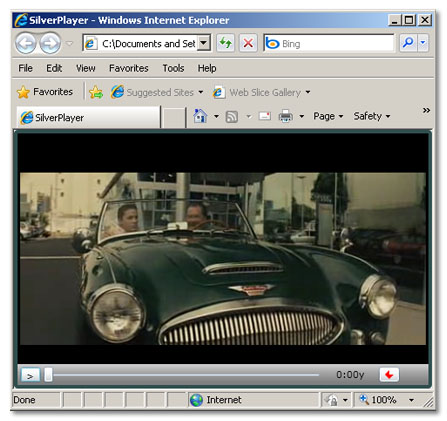
Technology
We’ll be releasing a high-performance decoder for Theora video / Ogg Vorbis audio streams that plugs into the Silverlight 3 streaming media abstraction, as well as a reference front-end player interface and JavaScript bridge layer providing basic compatibility with standard HTML5 media tags, adding support for the standard to Internet Explorer and extending the capabilities of WebKit-based browsers like Safari and Epiphany. A cunning plan, one might say!

High-performance managed theora / vorbis decoder? This is sorely needed, not only for Silverlight / Moonlight but also for standalone applications and especially games written in Mono/.Net.
Something is telling me that “Highgate media suite” won’t be a free offering, though… What are the chances of a reasonable pricing scheme for hobbyist developers?
@Anon: let’s see. I don’t think people will pay to get webvideo with theora, they’d rather invest in flash/h264 licences.
And I think someone started an open implentation of Theora in C#/Mono already, so maybe this is just the final product?
Mike: Yeah, there is some history. A port of just the Vorbis audio codec from jorbis (Java) was done many years ago in the early days of Mono (in fact I wrote Platano media player built around that almost a decade ago). This was actually a great test suite for the fledgeling mcs compiler.
The task of decoding video and synchronising it with audio has proved a significantly more complex challenge and the existing C# projects stalled at an early stage as far as I’m aware.
Indeed even Highgate media suite is not a ground-up re-implementation but reuses many algorithms and ideas from existing implementations. It is however finely tuned to the capabilities of the CLR platform and takes full advantage of what’s available there.
Yes, I will pay for h264 lincences instead a free and better theora codec for my next product. It sounds very smart.
You mention a release. Will this be open source? Where can it be downloaded from?
Anonymous, Silvia: We’re going open source with this! Over the last few years we found that our main business of developing mobile / custom web browser technology is getting more difficult with the demand for proprietary and patent-encumbered formats on the web which we simply can’t support. Perhaps a quarter of our developer time last year was spent trying to hack around bugs in the Adobe Flash player product, for example. So part of the strategy has been to encourage open formats, which means getting it in the hands of as many people as possible 🙂
These are the exact same reasons for our push on web standards and web accessibility incidentally.
That totally rocks! Awesome!
Alp, I owe you a Westvleteren for this at the Delirium cafe in Brussels. Promised.
Philip! I shall take you up on that.
Meanwhile, there’s a new compiler I need to show you..
Hmm, crap, looks like they don’t have Westvleteren at Delirium
Lol, Westvleteren is sold at the abbay store exclusively, and you need to make a reservation by telephone, several days in advance.
Alp: That is great, great, great, great news!
Great news.
Thank you!
Wow Planet GNOME has turned in to a Microsoft partner site. Wow congrats GNOME for selling out.
Never mind HTML5, Theora, open codecs or anything that might be mentioned in the article, it’s all an evil Microsoft plot in disguise!… So obvious!
¬_¬
What twisted mind equates an implementation of Theora and Vorbis to a Microsoft sellout? How can someone be so blind to the fact that this effort promotes an *open* and *patent-free* standard over proprietary solutions that are in wide use today (MP3/H.264)?
Beautiful!
Absolutely brilliant!
I cant wait to see you at FOSDEM!
Miguel
Likewise Miguel! Should do dinner. I know good place for mussels, even if it’s not quite Legals..
Nice to see you back into blogging Alp! Keep pumping great tools. Too bad I won’t be able to attend Fosdem.
Baris.
This is wonderful news, leveraging Silverlight for good for once. And to all you h.264 fans out there, aside from dissing Theora you might remember that a free viable competitor will help to keep the mpeg-la protection racket from skyrocketing their fees too much.
great effort! unfortunately it doesn’t cover the iPhone but of course for the iPhone nobody can do anything about it except Apple… let’s see how this whole format war pans out but currently it doesn’t look too good for theora 🙁
Could this be incorporated into to the “video for everybody” [http://camendesign.com/code/video_for_everybody]
so that only OggTheora would be needed on a website?
Web-videon vapauden näkymät paranevat…
Tulipa juuri hyviä uutisia, jotka vaativat vielä pienen lisäyksen aiempiin Web-videota koskeviin kirjoituksiini: Alp Toker julkisti Microsoftin Silverlight-alustalla toimivan Ogg Theora-soittimen. Soitin ei vaadi käyttäjältä mitään asennustoimenpiteitä…
Rock on, Alp! This is awesome news!
Given that Ogg Theora support is baked-into Firefox and Chrome, what’s the benefit of this? Allowing Windows users to view Theora in IE? Shouldn’t we just be encouraging them to use better products?
Windows/IE is not the whole world. Plus, desktop applications also stand to profit from this initiative.
How? Shouldn’t desktop applications just be using gstreamer?
Ever tried to use gstreamer from a Mono application? It’s painful.
anything gstreamer is painful
Well, its an opportunity to put Ogg Theora in front of a majority of online users. Hate to break it to you, but IE still has an overwhelming market share. In addition, Silverlight also works on Macs, so you get Safari as well. Believe it or not, not everyone in the world runs Firefox on Linux.
The biggest point as far as the web is concerned is to enable _websites_ to use Theora without sacrificing most of their potential viewers. IE isn’t going to go away any time soon, and neither is H.264, but with this, at least going with Theora becomes a viable option as far as browser support is concerned. Thus there will probably be more Theora content available than there would otherwise be, which is a win for free browsers and players also.
IE doesn’t support html5 video and safari doesn’t support OGG, so this silverlight decoder will virtually make your video visible in every browser on any system (assuming that moonlight will be ready by the time)
also, currently you can’t do fullscreen within a browser. since this is a silverlight application it will enable fullscreen video.
Actually, fullscreen video support is in Firefox 3.6.
oh dear. Richard stallman was right. I didn’t thought i would care about mono, until i saw a screenshot of ie on planet.gnome.org. That’s disgusting!
This news is interesting for web developers, and the vast majority of web developers (especially professional ones) need to care about IE.
It would be pointless to show the same screenshot in Firefox or another browser, as they can already play HTML5 videos natively. So yeah, please get off your high horse.
[…] full post on Hacker News If you enjoyed this article, please consider sharing it! Tagged with: Codec • […]
Which means Wikipedia users will be able to watch the videos without waiting thirty seconds for Java to start up. WIN.
Once we find out how to do it with MediaWiki, of course. What will it be able to run on/be served from?
Not sure I understand this. So, are you taking the HTTP stream and routing it through Silverlight once it’s reached the browser to provide codec support? Or are you making a way to pipe Theora to clients through a Silverlight thing, such that the developer has to use Silverlight technologies to encode the video?
If it’s the latter, it’s wrong. I hope and trust it’s the former. Nothing against MS technologies as long as data formats are respected and work across platforms without imposing how it should piped down by the server.
THANK YOU for this – an open source implementation of Ogg streaming as a Silverlight/Moonlight plugin is a giant ray of hope in the current nasty situation of codec wars. 🙂
Now we just have to hope everybody on the OSS side doesn’t decide to abandon Ogg for Dirac and put it back at square one!
[…] According to Nuanti developer Alp Toker, the company plans to open the source code in order to enable broader adoption of open and unencumbered video technology on the Web. He revealed some details about the project in a recent blog post. […]
I haven’t seen that many tech words in a title that didn’t include the word “killer” in it in quite some time!
So is this similar to the Java cortado plugin, just in C# with JS hooks? Or is it the theora + decoder C libraries ported to some SL plugin infrastructure?
He mentions it’s “fully managed” – eg C# (or VB.NET 😉 ).
The “fully managed” and “installation-free” parts seem to strongly indicate “similar to Cortado with JS hooks”. The “managed” portion basically means that it’s fully confined to the .NET VM, requiring no native code (and thus Silverlight will happily run it without bothering the user much about it).
@Christopher Blizzard: It’s plugging into the Silverlight architecture. See the link below for a blog entry by Miguel de Icaza.
http://tirania.org/blog/archive/2009/Mar-23-1.html
@alp Is there a separate Vorbis decoder for SL?
[…] Until 2016.Enter Ogg Theora (Wikipedia). It licensed under the LGPL and BSD. It is an open standard.And it's been implemented in Silverlight!This could been big things for Theora as the Silverlight implementation requires no extra software […]
Web video controversy summarized…
This’ll be the last, definitive article from me on this subject for a while, I promise, but I wrote such a good summary on the Theora/H.264 controversy and the new Silverlight Theora player on Slashdot that I must put it up here as well (with some twe…
[…] Alp Toker detalha mais o projeto em um recente post em seu blog. […]
Opera, anyone? Full screen mode, Ogg support. We love you long time now!
My poor browser, so misunderstood and under-appreciated.
But very happy to hear of a solution that will be open-sourced and allow for faster cross-platform adoption of embedded video.
Molly 🙂
[…] where Miguel shortly presented the Pinta paint editor and Alp showed us Moonlight player which used fully-managed Theora codec to play the movie. These demos were followed by series of in-browser and desktop Moonlight […]
But I was told by a secret source at Apple that plugins were evil and that HTML 5 was going to save us all from plugin prison! Does this mean there are good plugins and bad plugins? And, how am I supposed to tell the difference??? There doesn’t seem to be an Object tag attribute you can set to good or bad? Not even in the HTML 5 draft. What’s a person to do?
Nice work by the way.